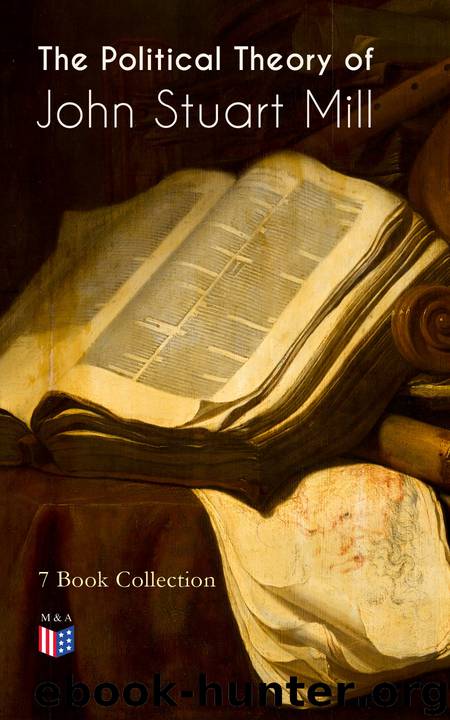
The Political Theory of John Stuart Mill by John Stuart Mill
Author:John Stuart Mill [John Stuart Mill]
Language: eng
Format: epub
ISBN: 9788026879251
Publisher: Madison & Adams Press
Published: 2017-08-13T04:00:00+00:00
1 Mr. Calhoun.
Chapter XVIII — Of the Government of Dependencies by a Free State
Table of Contents
Free states, like all others, may possess dependencies, acquired either by conquest or by colonization, and our own is the greatest instance of the kind in modern history. It is a most important question how such dependencies ought to be governed.
It is unnecessary to discuss the case of small posts, like Gibraltar, Aden, or Heligoland, which are held only as naval or military positions. The military or naval object is in this case paramount, and the inhabitants can not, consistently with it, be admitted to the government of the place, though they ought to be allowed all liberties and privileges compatible with that restriction, including the free management of municipal affairs, and, as a compensation for being locally sacrificed to the convenience of the governing state, should be admitted to equal rights with its native subjects in all other parts of the empire.
Outlying territories of some size and population, which are held as dependencies, that is, which are subject, more or less, to acts of sovereign power on the part of the paramount country, without being equally represented (if represented at all) in its Legislature, may be divided into two classes. Some are composed of people of similar civilization to the ruling country, capable of, and ripe for, representative government, such as the British possessions in America and Australia. Others, like India, are still at a great distance from that state.
In the case of dependencies of the former class, this country has at length realized, in rare completeness, the true principle of government. England has always felt under a certain degree of obligation to bestow on such of her outlying populations as were of her own blood and language, and on some who were not, representative institutions formed in imitation of her own; but, until the present generation, she has been on the same bad level with other countries as to the amount of self-government which she allowed them to exercise through the representative institutions that she conceded to them. She claimed to be the supreme arbiter even of their purely internal concerns, according to her own, not their ideas of how those concerns could be best regulated. This practice was a natural corollary from the vicious theory of colonial policy — once common to all Europe, and not yet completely relinquished by any other people — which regarded colonies as valuable by affording markets for our commodities that could be kept entirely to ourselves; a privilege we valued so highly that we thought it worth purchasing by allowing to the colonies the same monopoly of our market for their own productions which we claimed for our commodities in theirs. This notable plan for enriching them and ourselves by making each pay enormous sums to the other, dropping the greatest part by the way, has been for some time abandoned. But the bad habit of meddling in the internal government of the colonies did not at once die out when we relinquished the idea of making any profit by it.
Download
This site does not store any files on its server. We only index and link to content provided by other sites. Please contact the content providers to delete copyright contents if any and email us, we'll remove relevant links or contents immediately.
| Anthropology | Archaeology |
| Philosophy | Politics & Government |
| Social Sciences | Sociology |
| Women's Studies |
The Secret History by Donna Tartt(19088)
The Social Justice Warrior Handbook by Lisa De Pasquale(12190)
Thirteen Reasons Why by Jay Asher(8910)
This Is How You Lose Her by Junot Diaz(6887)
Weapons of Math Destruction by Cathy O'Neil(6280)
Zero to One by Peter Thiel(5802)
Beartown by Fredrik Backman(5754)
The Myth of the Strong Leader by Archie Brown(5507)
The Fire Next Time by James Baldwin(5446)
How Democracies Die by Steven Levitsky & Daniel Ziblatt(5219)
Promise Me, Dad by Joe Biden(5153)
Stone's Rules by Roger Stone(5088)
A Higher Loyalty: Truth, Lies, and Leadership by James Comey(4964)
100 Deadly Skills by Clint Emerson(4925)
Rise and Kill First by Ronen Bergman(4789)
Secrecy World by Jake Bernstein(4753)
The David Icke Guide to the Global Conspiracy (and how to end it) by David Icke(4720)
The Farm by Tom Rob Smith(4513)
The Doomsday Machine by Daniel Ellsberg(4490)
